Happy from Giving Thanks

Each November, we attend a community breakfast of thanks and giving. Last year when I attended the breakfast, a speaker talked about the value of practicing gratitude. His message hit home for me. I have always been thankful for the advantages in my life and have always been big on saying thank you. His message had me thinking about true gratitude. Do I notice enough when people come into my life who help challenge my thinking or add something to my life that I had no idea was missing? Do I do enough to show my appreciation when someone goes out of their way for me? Do I show my gratitude for the work I am able to do, or am I too focused on the wrong things? Do I take time to be grateful for the small things instead of always looking for the big ones? Do I think about gratitude more often than one week of the year in November?

I started doing some research about gratitude and found many articles and great blogs on how it can actually make you happier and is a pretty simple thing to do. As a special education teacher for many years, I learned to live in a world of small miracles. My learners and I spent a lot of our time together talking about where each individual skill was growing, measuring progress in small steps, and taking time each day to recognize and celebrate the small wins along with the big ones. As adults, we don’t do that enough for and with ourselves and each other. We tend to measure our progress in major milestones instead of taking time each day to reflect on a few things we did well and be grateful for who and what we have in our lives. A year ago, I started spending time thinking about and writing down things for which I am grateful. It was not hard to find them when I started to look and most of them ended up being small things that helped my day take a slight shift for the better, even when it was a good day.

My job is intense, I teach part-time at a local college, and I try my best to be a good wife and mother who volunteers at the school events and helps when I can with all the extra-curricular activities. People often say things to me like, “I don’t know how you do it all.” To be really honest, I never have any idea how to respond to that statement as I do not think I am actually trying to do more than anyone else nor could I do it all if I want to do any of it well. I just do the best I can each day and wake up the next day and try to do it all a little better than the day before. On my drive home, I spend some time appreciating what I could and did get done. Many others do some of the things I attempt to do way better than I can, which I try to celebrate with them. I forget to turn in permission slips and sometimes we are late to school because that was just the morning we were having, and that is okay. Practicing gratitude helped me let go of the things that didn’t go well and value the ones that did more. The one answer I often give to that statement that is very genuine is that I have amazing people around me who work with me to get things done and remind me how to worry about being my best self instead of what anyone else may expect of me. At the end of each day, my husband and my kids always come to mind first, but it is also often my work family that ends up in my thoughts.

Recently, I had a tough couple of weeks between some big things happening at home and work. Whenever I hit a rough patch, I try to slow down and take inventory of all the positives I have in my life. I usually spend a couple of hours at the Hallmark store choosing just the right card and write notes to people that I am grateful are a part of my journey. In the midst of my tough weeks, we needed to interview for a new member of our team as we have a support staff member who is going to retire soon. Our interview questions were interesting, to say the least. We asked how you respond when there are seven of us who all have different needs and communicate in different ways (some of which are only through GIFs and emojis) and who may all need something done at once. We asked how much structure you need in your day as ours rarely starts and ends the same way. We asked how the person will balance multiple projects at one time and shift course quickly if a school has an immediate situation that needs all of our support. We asked what brings you joy and how we can support you when you get stuck. We laughed at some of the questions as we asked them and the stories we told to explain the work we do. At the end of all the interviews, we had several people who were excited to take on the job. They each shared how they felt a really positive vibe from our team and talked about how amazing it must be to support great work in schools so children get the best opportunities in life.

It was just the moment I needed to remind me how incredible my job is and how lucky I am to get to do it with each of my teams. I really don’t see my job as one I “have” to do. Don’t get me wrong, there are parts of it I do not love that are things I “have” to do. However, my primary job is to support teachers and leaders to ensure they have what they need to create equitable opportunities for all learners that go well beyond high school. That’s the job I get to do each day on behalf of many learners, especially those who need school the most as poverty and trauma have denied them some opportunities outside of school. I am grateful each day for parts of my job. The day of the interviews, it hit me exactly how grateful I am that I get to do the whole thing. It is not the easiest job out there, but it is one that gives me a sense of purpose and reminds me each day what matters most.

At the breakfast this year, the speaker again talked about gratitude. He said, “It should not be Happy Thanksgiving, but instead I am happy from giving thanks.” I am happier when I give thanks for what I have and what I get to do each day at work and at home. What I am most grateful for each day is always the people I have in my life and the relationships I have with them as they matter and make all the difference.
The Power of a True Community

“There is a yearning in the heart for peace. Because of the wounds and rejections we have received in past relationships, we are frightened by the risks. In our fear, we discount the dream of authentic Community as merely visionary. But there are rules by which people can come back together, by which the old wounds can be healed. The purpose of Community Building is to teach these rules- to make hope real again- and to make the vision actually manifest in a work which has almost forgotten the glory of what it means to be human.” 

     -M. Scott Peck MD, author of The Road Less Traveled

This statement is the vision of a community building workshop that I had the opportunity to participate for three days last week with staff, parents, religious leaders, law enforcement, and other community members. It was an emotional experience wherein we shared our own stories and heard the stories of others so we could learn to empathize and grow together to build a stronger community. At the end of three days, I felt exhausted and completely exhilarated at the same time. We found connections with one another that we had no idea were there and learned to sit in silence with each other at times to make space for everyone to process and feel. We all entered the experience having no idea what to expect and getting little to no direction from the facilitators, which was really frustrating at first and made total sense by the end. After the three days, we were tied to one another with a tight bond that helped to heal some wounds and certainly made me feel hopeful about how we can make those same connections in classrooms and with families. 

After the first day of the workshop, I went to teach a class for pre-service teachers at one of our local universities on inclusionary practice for children with special needs. It was the first night of face-to-face class as the first half of the course was held online. As I drove there, I could not stop thinking about the vision of our workshop. Our classrooms and schools need to be places where we make hope real again and remember what it means to be human. We have to be less focused on finishing a textbook or getting through our curriculum and more focused on making sure our learners feel a sense of belonging and that they are a part of something important at school that translates into skills in life. 

As the college students entered class, I shook each person’s hand and introduced myself, which seemed to surprise them. Many of them spent a few minutes before class expressing frustrations about challenging students they encountered in their student teaching placements. As I listened to the challenges, that vision again came to mind. We started class by talking about empathy and why it is so essential when working with each other and all learners, but especially those who have disabilities or those who are disconnected from school and life. We spent a lot of time that first night talking about creating community in the classroom, how to help learners find access points to grade level material, and the importance of making sure content is driven by student interests.  

I invited a math and a special education teacher who co-teach at one of our high schools speak to the class. They talked about how much easier teaching is when you have a true collaborative partner and ways they have found to connect the material to some of the most challenging learners. They shared stories about the successes they have found in developing relationships with learners by knowing their interests and their future plans.  I asked them at the end to share their favorite part about teaching. They each talked about the sense of purpose they feel in giving back and connecting with the learners who need school the most as sadly they do not have the opportunity to make those connections or feel that sense of community anywhere else in their lives. 

By the time our class had ended and the last student left over an hour later, I had gotten the chance to hear about what many of those students are going through while attempting to complete college, successfully student teach, and have lives outside of both. Many of them have partners and children as well, which makes it all even more complicated. I made some adjustments to the syllabus that night as I learned what the students wanted and needed to know. I added opportunities to learn about Restorative Practices to help create a sense of belonging in every classroom so learners want to be there and want to work hard. 

We often focus on creating relationships between our learners and ourselves, but do not always work on the relationships they are creating with one another. A restorative classroom starts with community building circles through which we can learn about the learners and they can learn about one another by asking a series of progressive questions. They start with low-risk questions about superficial topics such as, “What is your favorite ice cream flavor?”. As learners begin to trust one another they ask high-risk questions like, “Describe a time you acted on your core values when others did not.” Circles can be used for relationship building or academic activities by asking questions related to content.

After students get to know one another through circles, it evolves into opportunities to support one another and eventually repair harm within a classroom when something goes awry. Restorative Practices are a way for learners to own their actions, take responsibility for them, understand the impact of them on others, and learn from mistakes to do better next time. Classrooms that are genuine communities are full of learners who are far more willing to try and fail as they know they have the backing and support of everyone else in the room. In our classrooms and schools that have embraced the restorative model, learners are able to host circles to help each other reflect on their reading at age seven. They are able to mediate whatever happened at recess without the teacher. They are able to keep everyone in classrooms and communities because they have the skills to work through conflict together within the class instead of heading to the office. We want learners to feel the same level of connection and trust with one another that I felt after three days in a room with people I did not know very well at the start so they can own every part of the learning environment.

I sent my college students a new syllabus later that night with a couple of the assignments removed and a new one to bring back to class the next week. I asked them to do empathy interviews with at least two students with these questions:

  • Tell me about a time you were successful in school.
  • Tell me about a time you struggled in school. What did you do?
  • What are three words you would use to describe this class?
  • What is one thing you wish teachers knew about you?

I cannot wait to see what insight this gives them about their learners and what we can do next week to continue working on how to create classrooms that are real communities where learners feel safe and inspired.  We get to try “to make hope real again- and to make the vision actually manifest in a work which has almost forgotten the glory of what it means to be human.” 

Learning From Each Other

I really enjoy our district-wide professional development days as they provide us with an awesome opportunity to connect with educators from across our district and to connect them to each other. Taking the advice of Shelly Burgess and Beth Hoef, “People are less likely to tear down a culture that they have helped build,” we invited teachers and curriculum leaders from all of our school sites to join a planning group with our district leadership team for the days this year. As we work to be clear in what we hold in common across our eighteen schools and what is a school or classroom level decision on how that looks, creating a district-wide plan for professional development that meets the needs of over five-hundred teachers and leaders is a challenge. We want it to be relevant to each classroom and each staff member’s personal journey, incorporate choice, and model great instructional practice. Building in time for seeing and doing with time to reflect, practice, plan, and engage in professional discourse were key to what we all agreed were the next steps for all our staff. 

After our first meeting, the team realized the challenge of giving all staff tools to move along a continuum of doing activities that empower learners to creating classrooms that are entirely learner driven to turning those classrooms into whole schools that are learner empowered. One thing that was really important to the group was more time to see the work in action and time to connect with other staff. As a group, we felt our staff understands our why of creating more equitable outcomes for all learners that go well beyond graduation from high school. It was time to dig deep on how to plan for and what learner driven instruction looks like in practice.  We would meet each week, send them back to schools to get feedback, and then evolve the idea until it is something we could put into practice. It has been amazing to get input and learn from our educators in this group and for them to connect back to all teachers. This has led to some healthy professional discourse on the how and what of the work we are trying to do and how to get all five hundred teachers invested in the process.

Our groups ended up targeting specific work for each grade band that was different. Elementary and intermediate spent time in small groups working on knowing our standards well enough ourselves to teach them to learners and empower them to take ownership of mastery of those standards within cross-curricular projects. All of our site visits have shown us that standards are an essential part of the work, but they do not have to be only understood and driven by the teacher. The learners can take ownership of the outcomes when they know what is expected of them and can do it in ways that reflect their interests. For our high schools, they felt a big picture approach was needed, which meant hearing from a learner panel of students in one of our sixth through eighth grade flexible learning communities and then having small group discussions on the big picture of what school could be.   

We wanted our teachers to know that how the standards are mastered in your classroom is about knowing yourself and your learners well enough to shift the learner experience wherever and whenever possible to be authentic with high levels of content mastery, problem-solving, communication, collaboration, and, most importantly, creating a sense of belonging to the group. We are pushing our teachers to realize that they get to decide on the instructional methods used in their classrooms and schools, which won’t look the same across our district. We trust them as professionals to make those decisions as they know their learners best. Each of these groups also then spent time in collaborative groups working together on breaking down an existing project to be able to understand how and where it becomes learner driven. We wrapped up the first part of the morning asking them to use a similar format on their own lesson and unit plans. Where could they be making shifts toward learner driven, authentic experiences every day?

As part of the opening in one of the groups, we asked them to answer this question with educators from other schools, “What will you make, build, or do with learners this year that they will be talking about in 10 years?” Most of those answers were around larger community-based experiences instead of daily classroom instruction. We followed the discussion with the question, “What will you make, do, or build tomorrow that learners will still be talking about in 10 years?”  We are hopeful that our teachers will use some of what they learned that day to have that question drive more of what we do.

Our staff also need to see this kind of work in action and what better way to learn than from each other. So, the second part of the morning was a choice of over twenty classrooms across our district where our own staff were willing to model learner driven practice in their classrooms. The staff shared what their daily practice is and other staff were able to watch, learn, and give feedback. The participants learned a ton about how to do this work from educators that may teach down the street from them who have already tried new ways of connecting to learners with both successes and many opportunities to learn how they would do things differently. The presenters got feedback on their practice and answered questions for the participants that allowed them to reflect on what they do and why they do it. This was the email we sent to those who were brave enough to go first, “We have asked each of you as we know you are trying new things, having some success with learners, and find joy in your work. We will have the groups be small (hopefully around 25) of teachers from across our district in the sessions. We are hoping you will model a lesson, talk about how you incorporate learner driven skills in new ways, and how you got started with making a shift. It is not expected to be anything that is “perfect” or a “show”. It is meant for you to share your experience with others and encourage them to try new things in the way you have.” We got some great feedback from both participants and presenters about the power of the experience. Some of the sessions went off without a hitch and others did not go exactly as planned, but every one of them provided staff with an opportunity to connect and learn from each other.  

We asked each building leadership team to build in time for reflection, discussion, and planning at the school sites.  We know how essential that time to think about what you learned and then collaborate with colleagues is to create space for a change of practice.  These shifts take a continuous conversation with time to think and time to plan. Finding more time is always a challenge in education, but we want to keep the learning and the learner experience at the forefront by helping staff to find the time where we can.  Teachers need to know we support them in trying new things knowing they may fail with opportunities for coaching and collaboration to know how to go back and try again. We get a lot of feedback that we need to make more time for processing and planning. We are working on new ideas to try some creative things  within our schedules for next school year to help. In the meantime, we need to continue the push and the conversation wherever and whenever it can happen.  

Nelson Mandela said, “Education is the most powerful weapon which you can use to change the world.” Targeted professional development puts teachers in the best shape to use the power of the weapon every day to empower our learners and therefore make our world a better place to be. 

What Will They Create That Will Make Our World More Awesome?

As we push for learning that is authentic and empowering for our learners, we decided to try something new this year. We decided to set aside some budget money to sponsor some student-led businesses as start-ups. I was curious to see what our learners would do if we gave them the opportunity to add something to the school that we had not done before and then actually let them do it. We put out a simple five-question form that asked about what kind of business it would be when they thought it would be profitable, and what they would do with the money. It was essential to ask them how they felt their business would make the school and our community a better place as well. It created a great opportunity to hear from some future entrepreneurs that are really inspiring. 

We got to hear from a group of five and six-year-olds about how they are doing a project to draw more families to move to our city. I had the honor of sitting on their expert panel a few weeks ago with our mayor and other city leaders to answer their questions about why I think West Allis is a great place to be. They are now making a promotional video and will be going public with their work at our local Farmers Market next month. They asked for a button maker to create promotional materials and some podcasting equipment as they are starting a learner-led podcast (Thanks- Award Winning Culture for an excellent idea!). The learners will be going out into our community to interview people and document their thinking and insights via their new podcast. This was the feedback from the teacher when I shared that we would be funding their project, “Our room was full of excitement and pride when we told them the good news. Thank you so much for taking the time to hear their ideas and for funding this project! There are so many exciting opportunities ahead for them!” That’s exactly how we want all learners and teachers to feel about school. 

Another elementary group had researched hunger, how it impacts the brain, and what the nutritional requirements are for schools. They proposed a snack store with healthy snacks to get learners through their afternoon hunger and be more productive. Their proposal was very professional and entirely done by the learners. They had dressed up and offered samples of all the snacks for the panel. You could see the pride in their work and the sense of community that had been built in their classroom as they worked together to answer all the questions we asked. That sense of belonging and community really came through when we asked them what they would do with any profits. Each learner talked about wanting to give to charities or support others in school and out who are struggling. The learners were from varied friend groups and able to see past that to want to create a collective impact on our community. Again, that is exactly how we want all learners to feel about school.  

Two young men from another elementary had a great idea to add a more exciting option to their Friday activities that is both educational and fun. They created an arcade on a cart that others can use if their name is called in a drawing. They had quite the sales pitch and are planning to take their proposal to a major supplier for more units once they have some promotional videos from learners using the cart. It was a creative idea that was driven by one learner who had not always felt successful in school. He had challenges connecting with his classmates and his learning until he got the opportunity to design a project of his choosing to demonstrate his learning. It gave him a new outlook on his learning, and I can confidently say he is able to communicate, research, problem-solve, and collaborate with others based on what he showed us in a fifteen-minute pitch. Being able to make his idea a reality through our student-led businesses means he will continue to feel empowered at school.  

Our high school and adult learners want to start a cafe, a t-shirt business, an outlet for students to express their feelings through art, a recycled t-shirt business, a photography studio that offers discount senior pictures for those who can’t otherwise afford them, and a greeting card company. One that really impressed me was a team of learners from our marketing class and our current student-led coffee shop run primarily by our learners with disabilities. They have been working on a revamp of the school book store together and wanted an investment to make it better by adding a satellite location for the coffee shop to it. The two teachers and an educational assistant had obviously collaborated on how to make the experience inclusive for all learners in a purposeful way that closes opportunity gaps. The learners worked together and presented a cohesive picture of what they wanted for their business. We continually reflect on our inclusive practices for students with disabilities as a district team. This was an exciting glimpse into what’s possible for all learners when the work is authentic, project-based, goes public, and the inclusionary practice becomes seamless and invisible in the work. When I asked this group why student-led businesses are important, all four learners gave almost the exact same response. They all said that they need to have real experiences in school so that they feel ready for life outside of school. The expectation for all these learners in this project will be the same, the pathway and the supports may just look different. ALL learners will get the opportunity to feel ready for whatever comes next for them.   

The sense of empowerment that every learner we spoke to demonstrated was remarkable. When we ask our learners to try with the right supports, they do, and they want to do more. As Kid President once said, “What will you create that makes the world awesome?” We have a bunch of learners who are about to see what they can create together. I am sure it will be awesome!  

Listening to What Matters Most

undefinedEvery year I attend graduation at what, until recently, was our alternative high school. It was a credit recovery school where learners who need an alternative pathway to graduation went after they had repeatedly failed at our comprehensive high schools. We are moving to a Project Based Learning (PBL) high school where we provide new opportunities for learners earlier to prevent failure and the need for credit recovery. They usually have two student speakers at graduation who tell stories of their challenging times in school and life before they attended our alternative high school and things turned around. The students are articulate, passionate, and often bring many in the audience to tears. They talk about finding their passions, connecting with teachers on a deep level, and learning resiliency skills at the new school. As I sat at graduation last June, I was struck by the power of what one learner had to say about her learning journey and looked around to realize more people needed to hear it.
I recently read a great post by A.J. Juliani called The Surprising Research about Students and Listening Skills. In it, he writes about an experiment where people missed a gorilla moving through a group of people playing catch as they were asked to focus on watching one pair throwing the ball back and forth. “This experiment reveals two things: that we are missing a lot of what goes on around us, and that we have no idea that we are missing so much.” I worry that sometimes what we are missing in our schools is the voice of our learner and we have no idea how impactful that voice can be to inform our practice. He goes on to write, “We have to admit to the fact that our attention does not always lead to full awareness. We have blind spots, and the real power is acknowledging our lack of complete awareness.” The post is mostly about how our students listen, but the same idea applies to our leaders and teachers. Is one of our blind spots to complete awareness of success in school not asking our learners, listening fully to them, and then acting on what they tell us?  

I asked the principal from our PBL high school to invite a panel of learners (including the young lady who spoke at graduation) to speak to our leadership team for our opening kick-off in early August. A panel of four learners spoke to our principals, assistant principals, district office staff, and instructional coaches that day about their experience in our schools. They shared stories of times they had felt successful throughout their school career, and what happened that meant in their junior or senior year they needed a credit recovery option. We learned a lot from learners our system had failed at one point and got it right at another. It was an amazing way to open our eyes to the urgency to get it right for kids and the power of what happens when we do. 

When we met again in September, we opened again with a learner panel. This time we chose a group from an intermediate learning community that is project-based, multi-age, and centered around relationships before content. The learners from this community said things like, “We are able to be leaders. We know that we can make change in our world. Our community is like a family.” The learners talked about closing their own gaps in math and reading because their work had purpose. They shared stories of projects they had created and connections to our greater community outside of school. These learners presented about their learning community in a break-out session at a national conference a few weeks ago. When the opening keynote for the day asked a question of hundreds of people who are leaders in our field, it was one of our learners who answered his question on why personalized learning is so important. She has found her voice about her learning and is not afraid to share it no matter how big the audience.

Our October learner panel was a group of high school students who were chosen to participate in the African American Male Initiative (AAMI). These learners were able to articulate times they felt empowered and supported, but also many times where they felt judged and undervalued. They expressed a sense that there are different expectations for them based on race and different responses to their behaviors than the reactions to their white peers. All of these learners are at our comprehensive high schools where our learning is still pretty traditional, but they have found opportunities to feel engaged and connected through AAMI, clubs, sports, music, and when they felt the teacher was kind and got to know them on a personal level. They are learning to become leaders within our schools with ideas on course offerings and training for teachers, but are also looking for more ways to be heard.  

One young man from this panel was quieter than the others. I had to ask him some probing questions to get him to share his story and he clearly felt nervous. I went to meet with him to thank him for being on the panel and reassure him that he had done a fantastic job. We acknowledged that it is not easy as a high school student to speak to a large room full of administrators and coaches. His entire face lit up during the conversation, and he said, “I get to do that again, right?” The smile on his face made my week as I knew we had given him a voice to share what he needs from school and empowered him through the panel to want to share it with others.  

All our learners have been able to articulate lots of bright spots, which is encouraging. We want to take the time to celebrate those moments. They were also able to articulate some areas for growth that had a common theme:

  • The relationship the learners have with the adults around them is the key to their success. When they felt they could trust an adult in the school and any teacher takes the time to get to know them, they thrive. 
  • They want school to be authentic, exciting, and project based. Each learner talked about the importance of learning being flexible, connected to their interests, and something they could do that would help the world be a better place. Young people want to know they are having an impact. School should be one place where they definitely get that opportunity.  
  • Learners want to be heard and asked about their ideas. They have interesting ones on what school should and could be that are all things we can do.    

We were fortunate to have George Couros with us for our first panel. He shared his thoughts on the experience in his blog and gave us some powerful tools to shift our practice in schools in a workshop for the rest of that morning. “Listening to students who “struggled” in the traditional setting of school (that were now all flourishing in new environments) is something we need to do more often, but listening is only a first step. When we receive the feedback, what will we do differently because of it, and how will the students know?” We have many staff reading his new book co-written with Katie Novak, Innovate Inside the Box. It is full of strategies to help us with exactly what our learners are asking for- ways to create relationships, innovative practices, and taking ownership of change.

In one of the panels, I asked a student what she will need from our high schools when she gets there. She paused and said that she didn’t feel she was in a position to change how a large high school runs. I explained that is exactly why she was on the panel and that she should share her thoughts with the high school leaders in the room. In Innovate Inside the Box, George quotes a colleague who once said, “It does not matter what your position is; you can influence change. If education is going to move forward, you can’t wait for ‘someone else’ to do it.” Our learners are the ones currently influencing meaningful change for us in our schools. I can’t wait to see where they take us next.

What made me better

When I reflect on my skills as a teacher throughout my career, I can think of examples of what I did well and a million things I would have done differently.  I am teaching a class at a local university this semester and know confidently that I am a better teacher now than I was when I was in the classroom. The opportunity to see other teachers in action in my leadership role for the last several years is what has made me better.  I get to speak to educators and learners all the time about what is working well in their classrooms and what they would like to see grow. It includes spending time in many classrooms where we and others are getting it right and learners can articulate the process of their learning in order to create great things. 

Professional development that is connected to a vision of our work with meaningful processing time to reflect is how we push teachers to move from single projects to true learner driven practice.  We take a lot of teachers and teams on site visits to schools in our area and across our country who are already doing the kind of work we are trying to do to see it in action. It is hard to find a large comprehensive system that is there yet, so we are often at small charters of specialty programs that are offshoots of schools.  The visits are always amazing as we are able to interact with teachers and learners and see learner driven practice, but often the most important part of the time is the meal after the visit or the long trip home where we can talk about what we saw, process, and plan for what parts we can implement within our system. The goal is not to replicate but to figure out how to ask the right reflective questions of ourselves and one another to tie what we saw to our personal passions and interests and figure out how to bring all of that together to shift the learner experience.

We also spend a lot of our time talking about how this is the kind of learning experience ALL learners should have.  It should not be reserved for some kids in special programs or special schools. The visits with the deep discussions are often the leverage point that takes an educator from trying a few things to a true shift of practice that is more inclusive.  It helps them to be more collaborative as they are often on these visits with other staff from across our district that they might not already know having a shared experience . The power in seeing some things we are already doing well and celebrating those helps us to not be overwhelmed when looking for ways to grow.  The key is to make the time, take the staff who are ready to take some bold steps, and then follow up with them multiple times throughout the year so they have support to keep going with the work.   

On a recent site visit, I took a chance and messaged some of the teachers to join us off-site after the formal conference to continue our learning.  Fortunately, they were willing to take the opportunity to discuss their work with us over dinner. It was an impactful experience to listen to teachers that have been doing this work for some time engage in professional discourse about grading, telling their story and standards.  The teachers were open about their own growth over time and how our staff could take pieces of what they saw back to our schools to create a more equitable opportunities for all learners through empowerment. We went back to the site the next day with a new lens on what to look for in learner and teacher observations that we could do instead of being lost in the surface things like the physical set-up.  Things that may have looked idealistic the day before now looked possible. The modeling of professional discourse created space for our team to do the same and ask some great questions about how we can do this work and how it does not have to look the same across all our schools.  Encouraging staff to push boundaries and challenge one another’s thinking is how we look at someone else’s professional practice and find a way to make it our own.

A few things we discover each time we do a site visit became apparent:

  • This work is messy.  It takes deep dialogue on what is right for learners and how to give up control in a way that is not always natural for teachers.  
  • Change is uncomfortable and unpredictable, but easier with the proper support.  People tend to say, “Change is hard.” There was a great article from the Harvard Business Review in January of 2008 that explained why that phrase becomes a self-fulfilling prophecy that permits us not to try.  We have to be able to think bigger than that.  
  • We need to get more comfortable with professional discourse and open discussion about where we are now and where we can go that may push our thinking.
  • Teachers have to connect their own passion to their work in schools.  When it is authentic to the teachers, it becomes authentic with the learners.
  • Our teachers need to see the work in action often and learn how to get and give productive feedback.
  • The standards are always embedded in innovative, learner driven work.  They just aren’t always owned solely by the teacher.  
  • Many times, the teacher in a learner driven classroom finds joy in their work.

We have evolved our district wide professional development to hopefully reflect all of these.  Our teachers will have time in small groups to learn their standards well enough to empower learners to take ownership of mastery of those standards within cross-curricular projects.  Staff will then have the opportunity to sign up to see another teacher modeling classroom practice that is learner driven. They will be our own internal site visits. We will use structured protocols to get and give feedback at each site to ensure we are using the time for genuine collaboration as we know that is what drives teacher practice.  We can’t make more time than we have, so we use the protocols from The School Reform Initiative as a way to restructure the time and make sure it is used for purposeful feedback and collaboration. 

Our teachers hosting visits that day have been invited to participate for the first round as they are already trying new things, having success with learner empowerment and finding joy in their work.  It is not expected that anything that is “perfect” or a “show”.  It is meant for one teacher to share their experience and encourage others to try new things with an open dialogue about how and what supports they will need. Our goal is that our teachers engage with one another to see what’s possible, work together to get there for every learner and find joy in the work.  

Don’t you already have a test that tells you I don’t know how to read?

Books HD

Several years ago, I was teaching reading to sixth grade students.  I had been teaching for some time, but had just returned from a two year leave after I had my twin boys.  As I met my learners and started to get to know them, I was quite surprised at how many of them were reading at a kindergarten or first grade level.  Many of the students were identified as having learning disabilities, but that was no reason for the kinds of gaps I was seeing. We spent a lot of time in the first few weeks of our reading class getting to know one another as readers and as people.  We talked about all kinds of books and what they liked about books. Few of them could think of anything they loved about books, which I thought was odd at twelve. At that time, we gave the Wisconsin Knowledge and Concepts Examination (WKCE) as our state-wide test every October.  As I was about to start the test with one of my learners, he said, “Don’t you already have a test that tells you I don’t know how to read?”  I paused for a long second and then replied, “As a matter of fact I do, but the state of Wisconsin would like me to give you one more. What’s good about that is I happen to be decent at teaching kids how to read, and we have almost a whole year ahead of us.”  His accommodations included reading the test out loud, extra time, and testing in a one-on-one setting. For the next several days I listened to him struggle over every sound and word. I listened as he tried to figure out the meaning of a text when he could only read one fourth of the words.  It was brutal and he knew it. You aren’t allowed to make a comment or give any assistance as it is a standardized test, so I just listened and got more and more angry. How could we have a system where this was a learner’s experience and skills in sixth grade? I LOVE reading and read all the time.  How could someone have deprived him of falling in love with a good book? He is really bright and funny. He didn’t particularly enjoy working hard yet, so that made our work together more of a challenge and gave us lots of opportunity for in-depth discussions about my feelings about potential and how you can’t waste it.  

I was pretty fired up after that test.  The rest of the learners in his class were in a similar boat.  In fact, some of them did not know the sounds of all the letters of the alphabet.  They each described previous learning experiences where they had either moved around to many different schools or when reading got hard they just checked out and someone allowed them to not engage.  I was fortunate to see them several times a day for reading though “intervention” classes and co-teaching. I read to them a lot to model fluency, we figured out what they were interested in and found as many texts as we could around each topic, we read grade-level text and struggled through it until we could decode all the words and then re-read it enough times to make sense of what it said.  I did my best to make them fall in love with books and what they could do for us as we started projects in other classes. My tester grew several reading levels that year. He didn’t completely close his gap, but he grew a ton and believed in himself and his reading in a new way. He was allowed to choose someone to give him the WKCE the next year and chose me so he could show me how he had improved.  Listening to him read this time still wasn’t perfect, but it was a lot better and he had strategies to use when it got tough that he was really proud to show off.  

At the time, I thought it was wrong that this learner and many others had so many “intervention” classes during the day, but it was the structure and what we thought was best then.  We now understand that pull-out intervention where we skill and drill the learners with programs is not the solution. Pernille Ripp has some great resources for empowering learning and inciting a passion for reading on her website: https://pernillesripp.com/.  “We’re constantly reading for skill,” Ripp says. “We’re constantly asking kids to do something with their reading, and then wondering why they’re choosing to leave us and never picking up another book. They can’t wait to get out of school so that they don’t have to read.” We want our learners to understand the power of a good book and the tool that reading is as they attempt to solve problems in our world.  

Stephanie Harvey and Annie Ward wrote an inspiring book, From Striving to Thriving: How to Grow Confident, Capable Readers.  One thing that really struck me was how important it is to be sensitive to the words we use to describe our learners. I was guilty of calling some of our readers “struggling” which labels and identifies them with a negative connotation.  I appreciate how the authors shifted the language to “striving” readers, which has shifted my language as well. The book focuses on the behaviors, attitudes, and understandings of a striving reader that teachers can and should pay attention to in order to encourage self-reflection, application, and conferring. It has some incredible strategies for teachers to understand how to build a classroom of trust where learners strive to be curious, have access to books that reflect their cultural identity, and have time to immerse themselves in them.  It is a book I wish I would have had when I was teaching reading all those years ago as it pushes on everything I was working on at that time and much more. We need to develop deep and meaningful relationships with our learners that are grounded in empathy across every context. Learners need choice, access, and time with books to shift their lens to what’s possible with a text. We need to connect what they read to how they think, feel, and what they want to do.  

In our district, we have made some significant shifts in our reading “intervention” in the last several years.  First, we stopped calling our staff “Interventionists” and moved the title to “Specialists”. We moved from a pull-out model of intervention kits to a push in model of co-teaching and coaching.  We’ve provided professional development in coaching and co-planning to co-serve as we know the best co-teaching partnerships are driven by the planning staff does together. As we dive deep into Project Based Learning, we are working to inspire learners to read with purpose and give them as much access to a wide variety of text as possible to help them in their research.  Our reading specialists are working on conferring with our striving readers. They will use conferring to empower by connecting on a personal level, enjoying a text together, observing reading behaviors, and helping learners to adjust those as needed to grow their reading confidence.  

As we look at our core classes, we added a read aloud series for our earliest learners that models how you can fall in love with a book as a best friend and go back to it time and time again to learn something new.  We are starting to do an analysis in our elementary schools on how much time we actually spend teaching reading and writing and if we are doing enough inquiry based instruction to incorporate science and social studies concepts.  We will also look at how are we spending that time to see how much of it is driven by learner passion and interests with enough time to practice with our guidance that hopefully keeps us from creating a gap in the first place. Looking at how much time we spend in grade level text and how are we inspiring our learners to have a growth mindset to scaffold through challenging text at all grade levels will also be part of our investigation of what we do now and where we can grow. 

We are in the process of adopting a new core resource for English/Language Arts across our district in the next couple of years. We are paying more attention to the research around the importance of phonics instruction in the early grades, how leveled text is intended to be used, and how we ensure our learners spend enough time writing. We want the resource to give our learners access to use their reading and writing skills to explore as well as to create. We want them to be able to tell and write their own stories about their journey as a learner.  They should not only be able to read the text of others, but also write their own.   

Maya Angelou once said, “The best part of life is not just surviving, but thriving, with passion and compassion and humor and style and generosity and kindness.”  I have always been able to find great models of thriving through books and the stories people tell of the world and their life experience. I am excited to continue seeing everyone connect great stories and factual knowledge so our learners can use it to thrive in whatever they do.  

A +2 Kind of World

My favorite TED Talk of all time is Rita Pierson, Every Child Needs A Champion.  If you have not seen it, I highly recommend you Google it.  In the meantime, here’s a recap:

When I was new to my role, I was warned that our elementary report card needed some work. That was an understatement. We had a report card on which a learner could get a “D” or an “F” in Kindergarten at age 5. We do the best we can with the information we have at the time, so I am sure when that report card was created it was done with good intention and the best information that team of people had at that time. However, educators and parents alike know a “D” is bad and does not promote a growth mindset. It demoralizes a learner who may be struggling and does not communicate anything about the specific skills that a learner has mastered and which ones still need work. The Massachusetts Institute of Technology (MIT) does not give grades in the first semester of freshman year. From their website, “The Experimental Grading Policy to Increase Flexibility for Exploration and Discovery in the First Year was designed to provide you with greater opportunity to explore fields of study at the beginning of your academic career.” If MIT, one of the top universities in the country, is looking at grading differently it is hopefully a trend for grading to be a mechanism to reflect, get and give feedback, and from which learners can grow.

In Every Child Needs a Champion, Rita tells a story of giving a student a +2 on an assignment that had twenty questions with a smiley face.  When the student asked Rita if that grade was an “F”, she said yes. She then asked him if he would do better when they reviewed the material. He said yes again.  She then said, “You see ‘-18’ sucks the life out of you. ‘+2’ said, ‘I ain’t all bad.’” We wanted to create a report card that is an evidence collection tool for skills that reflects a +2 kind of world. 

Our learners should feel empowered to demonstrate their current skills and know they will develop the ones they need most over time with our guidance.  These include ways to help them become self-directed, show content knowledge, and demonstrate problem solving and communication skills as we know how essential it is to master things beyond just academic content.  Our new elementary report card measures things like:

  • I can contribute responsibly in partner and group settings.
  • I can use strategies to manage emotions.
  • I can show consideration for the rights and feelings of others (empathy).
  • I can experiment with both 2D and 3D using a variety of materials.
  • I can apply what I have learned while I am playing a game.
  • I can use pictures in a text to help me understand it.
  • I can explain ways to reduce, reuse, and recycle.
  • I can use information to give evidence that Earth events can happen quickly or slowly.
  • I can decide if my answers are reasonable using mental math and estimation strategies including rounding.
  • I can analyze where and why people live where they do in the world.
  • I can describe how a narrator’s or character’s point of view influences how a story is told.

It needed to reflect the skills written in learner friendly language so they can demonstrate ownership of their learning with a measurement that shows a checkpoint instead of an endpoint.  A solid grade reflects an endpoint; the learning of that quarter or lesson is done. An evidence based report card with the right kind of measurement tools creates a checkpoint that encourages learners to continue to grow.  It is also flexible so a teacher can work on different skills at different times throughout the school year. We will continue to have standardized checkpoints at which time we will close a quarter and communicate formally to parents, but which skills go in which quarter is up to the teacher and the learners.  To support our teachers, we created curricular guides where the key state standards for every subject are broken down into an “I can” statement with a list of the resources we own to help teach that skill and a demonstration of mastery. The list of resources are the units or lessons out of the core curricular sources (textbooks, online platforms, instructional kits, etc.) we have adopted over time.  Each guide is written in a way that allows the teacher to decide how frequently s/he needs to access the resource. It shows which specific units are tied to help master each skill. For new or struggling staff, they may use the guides or our sources more closely. Other staff that are ready to use standards flexibly across content areas only use the guides when they are stuck. The guides are still a work in progress for us and always will be as we continuously learn more about what our learners and our teachers need for support.  The teachers get the opportunity to work on them over the summer each year to refine and continue to develop them. The goal is that a teacher doesn’t teach from a kit or a textbook, but uses those sources as needed to ensure learners have every opportunity to demonstrate mastery of a skill through authentic learning tasks.  

Our measurements are the best part of our new report card as they say something about our philosophical belief about our learners.  Janelle Monae once sang a great song on Sesame Street called, “The Power of Yet”. It includes lyrics like:

The goal I’m after is enormous, but I’ll achieve it

I’m just not there today

I can clear the highest hurdle if I believe it

Then I’ll be on my way

I have used that song and other inspirations to add “yet” to my vocabulary all the time as my way to live in a +2 kind of world and model a growth mindset.  Our measures for our learners on their elementary report card will be: Mastery, Progressing, and Not Yet.  

Not Yet is my absolute favorite part!  It communicates that you can still master the skill with more time and that it is our expectation that you will because we believe in you.  Not Yet reflects that it is still possible verses a dead stop with a judgement.  There is a point at which learners need to move forward and master a new set of skills, so the teachers will continue to monitor and provide more intense supports throughout the year as needed for learners who stay in Not Yet for multiple skills over long periods of time.

As an opportunity to continue to empower our learners, they will have the ability to contribute their own thoughts about their evidence of learning and self-asses.  Parents will know exactly what their child has mastered and with what that learner still needs our help or more practice in order to see mastery. We are also working on parent samples for each skill so they can continue practicing at home and will feel more connected to the learning process.  I am really proud of our committee of teachers, parents, and leaders who worked together to develop the report card that really is a way to measure progress towards the skills we know matter with a message that our learners can own.  

Tom Schimmer has a great quote, “Grading does not improve learning, in the same way a scale does not cause someone to lose weight.” The scale just helps you gauge progress towards a goal just like our new elementary report card.  

The Time I Almost Got It Right

We are getting ready to move, so I was clearing off some shelves in our home and came across a letter of recommendation a former student wrote for me.  J is ridiculously smart and creative. She has some significant mental health issues that often made school challenging for her. When she was having a really bad day, I would ask her to journal, write children’s stories, or make powerpoint presentations on random topics which gave her mind something to focus on when she was not able to manage herself or her thoughts.  Here is the letter she wrote for me:

I’ve known Mrs. Deidre Roemer for a year now and Ive got to say she has helped a lot in the past from time to time she has always been there when I have had difficult tasks that needed to be done. Mrs. Deidre Roemer has also helped me a lot with my ability to understand some of the projects and homework sheets that I might have needed to catch up on. If it were not for Mrs. Roemer’s generosity and time I wouldn’t be able to write this letter and probably would still be in the 6th grade. Therefore she is my hero and nominee for this award that she should receive. Last year I and Mrs. Roemer had troubling times that we went through together and I must say that I have become a better person since Mrs. Roemer came into my life. Since Mrs. Roemer has left my school and barely has any time to come and visit Ive had some troubles paying attention in my classes but sometimes I just have to try and manage without her. She has helped me get my education and carry out with my career pathway, and I think that that is all she needs to do in order to already be #1 in my book, what about yours? 

Sincerely and proudly, 

J” 

A flood of emotions hit me the minute I read it.  I had clear memories of our time together and how challenging it was on some days.  She helped me to understand real empathy as she was always able to share her perspective on her thoughts even when her mind was somewhere other than school.  She had insight into how her brain worked and her own mental health that I found fascinating. She prompted me to start doing a lot of research on brain function and helped me to understand trauma and its effects on the brain years before that was something we all focused on in schools.  


When I read the letter the first time, I felt really good about what I had done for J.  I read it again and realized where I almost got it right. So much of what she said in the letter was about what I had done for her.  I engaged her in school in a way that connected to her and helped her grow. What I did not do for and with her was empower her to take charge of her own learning.  I moved into a leadership position in our district at the end of that school year and she struggled. Too much of her education and success was dependent on me and what I was doing for her.  What I needed to do was do things with her to empower her to take charge of her own learning.  “Mrs. Roemer has left my school and barely has any time to come and visit Ive had some troubles paying attention in my classes but sometimes I just have to try and manage without her.”   In his book, Innovator’s Mindset, George Couros said, “Engagement is more about what you can do for your students.  Empowerment is about helping students to figure out what they can do for themselves.”  I definitely engaged J and sometimes empowered her, but not often enough that she could do it when I was not there.  Her learning should never have been about me. It should have been about her.  

As I thought back on my time with J, I wonder if I had had more time with her if I would have been able to help her move from engagement to empowerment.  In his new book, Innovate Inside the Box, George wrote, “ “It’s okay, good even, to look back. Just make sure that you are practicing meaningful reflection, not self-loathing. Reflecting empowers you to move forward and take action instead of getting stuck in that cycle of regret or jumping into the hamster wheel of rushing forward and not even taking the time to look back.” It is important to reflect on that time with J so that I am able to move forward in the work I am doing now.  I get to work with teachers and leaders to help them understand how to connect to students, understand them from an empathetic lens, and help them to grow in their abilities to self-advocate and be agents of their own learning.

Where is the leverage point that helps us tips the scale from doing for learners to doing with them?  How do we continue to engage in our own reflection and get our learners to do the same in an effort to always get better?  It is so important for us to think about the work in terms of iteration and bright spots. The time I almost got it right is a bright spot.  What I might have done with more time is take that bright spot and iterate until I could help J move the needle to take the ownership of her own learning.  How do we see our learners from an asset based lens to help them leverage what they know about themselves and their own learning to be the point that they feel empowered to take charge?  In looking at J from an asset based lens, I could see her brilliance -what she understood about her thoughts and her mental health at age 12 was amazing. Instead of being overwhelmed by what she could not do and her barriers, how do we see her for what she could do and use the bright spot to leverage agency? 

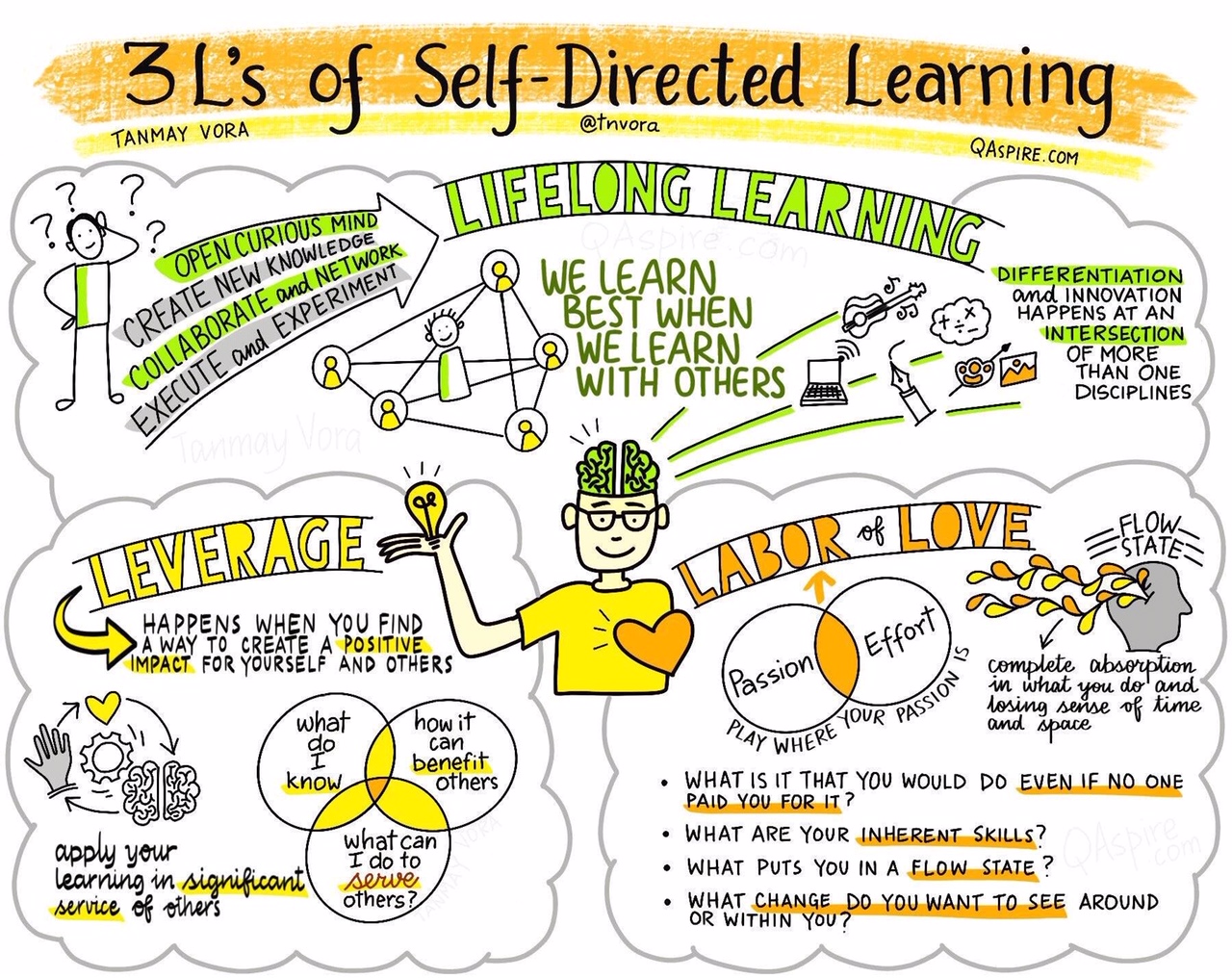
I came across this graphic from Tanmay Vora recently which helped me to answer some of those questions that I would have used with her and other learners at that time:

Unfortunately, J left our district, continued to struggle throughout school, and ended up dropping out.  Reflecting on her story had helped me to know that we are on the right track with using empathy interviews with all learners from a very young age to understand their perspective and share the process of owning the learning.  Some of the questions we ask are; “Tell me about a time when you felt successful in school.” “Tell me about a time school was hard.” “Tell what supports you will need from me when you struggle.” “What advice would you give me about our school?” “If you designed your own school day, what would that be?” Those inquiries help us to know our learners’ bright spots to help them leverage their own success without doing too much of it for them.  I am not sure doing things any differently with her in sixth grade could have changed J’s path, but what if it could have?

Diorama Farms

When I was in elementary school we used to get assigned to make a couple of dioramas each year. My dad loved building my dioramas. He would take me to the hobby store where he would purchase supplies to “help” me build one and work on it long after I went to bed. I would wake up in the morning to these awesome displays inside an old shoebox that demonstrated everything I had learned about the Navajo People, the Serfs of medieval times, and many other periods throughout history. We would talk about them at length when they were done so when I went to class I could speak articulately on why our shoebox really exemplified what I knew about history. There would be rows of them across the windowsills of our classroom like we had grown our own diorama farm. On the last day of the presentations, the shoeboxes would all be taken home and as if nothing happened we would be back in desks and rows diagramming sentences. Don’t get me wrong, I loved my time building dioramas mostly because I loved spending that time with my dad discussing why he thought the moss should go up the walls of the shoebox and where the trees should be glued down. It was a great effort by my teachers at that time to let us get creative in demonstrating our learning through a different product than our usual test or paper.

In my current work, I try to help our teachers and leaders understand why we don’t want to stop at building diorama farms. The one and done approach to learning with no meaningful connection to the process of that learning is the issue. I could not tell you what I learned about the evolution of my thoughts about a particular time period in history from building those dioramas, or that I did anything with my knowledge after that moment in time. What I can remember vividly was the time spent with my dad and his enthusiasm for the project. The development of a different kind of product helped me to develop a closer relationship with my dad, which certainly had an immense value. We can never underestimate the power of building relationships with others, but as teachers we need to be able to leverage those relationships with learners so that they feel a sense of belonging and want to work hard at things they are passionate about. We want our teachers and leaders to iterate beyond short-term products to really understanding the process of learning that is embedded in true Project Based Learning. Our learners should have the opportunity to demonstrate their skills in communication, collaboration, problem solving, and content mastery around multiple iterations of an idea that may finally lead to producing a product. We need learners to live and breathe in their work- both their great ideas and the ones that didn’t work. Our best ideas often come to us from failed attempts to accomplish a task or learn something new. We don’t want our learners to take their shoebox home at the end of the project and throw it away. Instead, we want them to take small ideas and make them big by reflecting on their work over time and growing from it. No one should beat themselves up for what they did not know when they tried something new or a failed idea, but we should see those attempts and be proud of the process we used to shift our thinking over time. We have to provide enough time for our learners to reflect on that process, document their thinking, and see it evolve or be something completely new.

One of my favorite parts of my job is planning meaningful professional development opportunities both in district and out of district for our teachers and leaders to know how to do this work and feel supported to try new things. We need to be able to give educators permission to try, get out of their way while they do, and then support them when it doesn’t go exactly as expected or celebrate with them when it does. Teachers need to feel that support from our entire administrative team with a framework and tools that keep them pushing for high levels of academic achievement, personal growth and inspiration in every classroom. We want to move beyond occasional creation of a product to a shift of how we learn together every day in every class. Our teachers need to feel good about that work with the support so they inspire learners to do the same.

Frequently when teachers begin to move to a project based approach they start by asking learners what they are interested in learning.  A teacher once shared with me that he always starts with, “What makes you mad?” The responses he hears are passionate and powerful. I use that now when I do interviews with our learners and my team uses that question to guide professional learning for our educators.  It is amazing to watch people’s faces light up when they tell what about their lives, our community, or our world makes them mad. When we create classrooms and schools where everyone’s job is to create solutions to what makes them mad, we will have ignited our learners to be future leaders who will work hard, are connected to their communities, push themselves to learn academic content, are assessment capable to show what they know when they are asked (even if it is on a standardized test), and are great problem solvers.  We are trying to prepare learners for jobs that have not yet been created in a world that evolves by the minute. I want to be sure we are creating consistent learning opportunities in every classroom to ensure our learners have the skills necessary to face those challenges with enthusiasm and continually grow from them as they go out into the world. It is exciting to think about what problems they will solve or what products they will create through the process that we don’t even know that we need yet, even if where that starts is with a diorama.